
TLDR: AI-driven search has shifted visibility from ranking alone to selection, summarization, and trust. Long-form content still matters, but only when it’s structured in a way AI can understand and reuse. Clear hierarchy, concise sections, intentional visuals, and well-built FAQs help content earn inclusion in AI overviews while remaining valuable to human readers.
At a Glance:
- Visibility now depends on selection, not just ranking. AI systems choose which content to summarize and surface based on clarity, structure, and trust.
- Front-loaded clarity drives inclusion. TL;DRs, early takeaways, and strong intros help AI understand intent quickly and reduce ambiguity.
- Structure enables safe summarization. Clean headers, short paragraphs, and logical flow make content easier for AI to extract and reuse accurately.
- Context builds authority. Purposeful visuals, descriptive alt text, FAQs, and internal links signal depth and increase the likelihood of being treated as a trusted source.
AI is rewriting the playbook for content discovery. Where content appears, what gets summarized and surfaced, and which sources are trusted: all roads lead through AI.
One common denominator? The rise of AI overviews, SGE responses, and zero-click results means structure now carries as much weight as substance.
Despite the shift toward AI summaries, long-form content remains vital to SEO and generative engine optimization performance. The key is knowing how to structure blog posts for AI search so content reads cleanly for humans and predictably for machines.
This guide breaks down everything you need to create content that earns inclusion, builds trust, and drives real results.
Why Structure Now Defines Visibility
Traditionally, search success meant where a page ranked in a list of blue links. If you ranked #1, you won. Traffic followed.
That’s no longer the full picture.
Today, visibility depends on how content is selected and used, not just where it ranks. AI systems now:
- Select sources to summarize before users ever see rankings
- Extract answers from multiple pages into AI overviews
- Surface content in SGE responses, knowledge panels, and zero-click experiences
- Decide trustworthiness before traditional ranking even matters
A page can rank well and still get skipped by AI. Another page can rank lower but get cited, summarized, or featured. In the example below, the second and third results of Google’s AI overview do not appear on the first page of traditional search results (but they’re some of the first things you see).

AI-driven systems decide which sources are safe to summarize, quote, and recommend. That decision hinges on clarity, hierarchy, and confidence. This is where AI search engine optimization becomes less about keywords and more about how information is presented.
Well-structured content gives AI fewer opportunities to misinterpret intent. It signals expertise quickly and allows models to extract accurate answers.
That same structure also improves user experience, making content easier to scan, understand, and trust. This dual benefit is the foundation of modern AI search optimization.
Lead With Clarity: TL;DRs and Early Takeaways
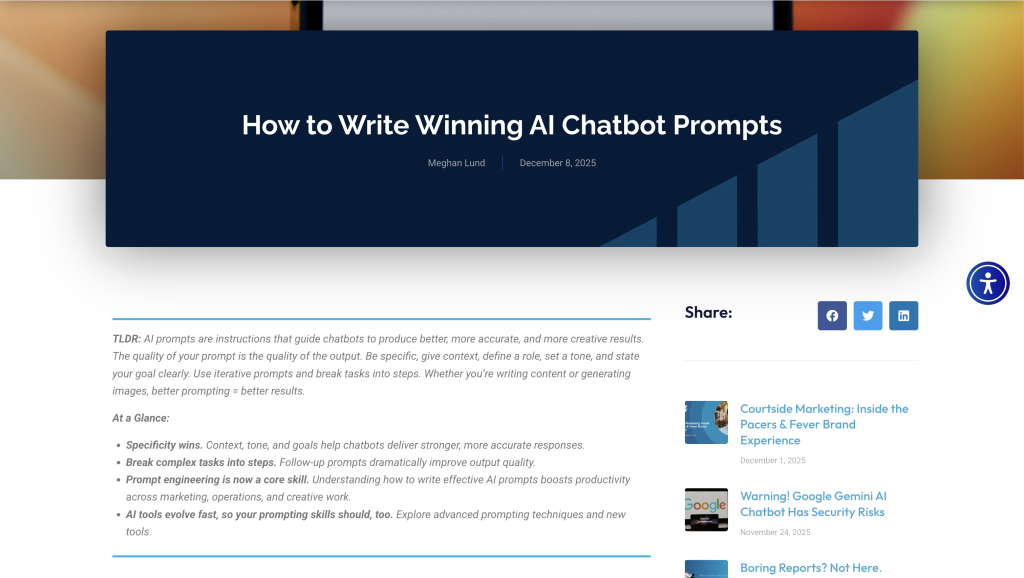
AI systems make decisions fast. They don’t read your content the way a human does. They scan for signals that indicate clarity, intent, and usefulness.
A TL;DR (Too Long; Didn’t Read, as named by Reddit threads and other discussion boards) at the top of a blog provides one of the strongest of those signals. It tells both users and machines exactly what the content is about and why it exists.
For readers, a TL;DR confirms they’re in the right place. For AI, it acts as a high-confidence summary that reduces uncertainty. It frames the topic, clarifies the problem being solved, and establishes that the content is deliberate, not exploratory.
Pairing a TL;DR with early key takeaways strengthens AI search content optimization even further. These takeaways function as structured proof points. They give AI clean, self-contained ideas it can lift without reinterpreting meaning.
The most effective takeaways focus on outcomes rather than tactics. They explain why the topic matters, what changes as a result, and what value the reader will walk away with.
Used together, TL;DRs and key takeaways reduce ambiguity at the exact moment AI is evaluating your content. They make it easier for models to extract accurate summaries and trust the page as a source.
At the same time, they improve human experience by making long-form content feel accessible. This is not about shortening your content. It’s about front-loading clarity so both AI and users know your content is worth their attention.
Write for Precision: Paragraphs, Flow, and Readability
AI doesn’t struggle with volume. It struggles with ambiguity. Long, dense paragraphs increase the likelihood that meaning gets blurred, compressed, or lost entirely when content is summarized or extracted.
Shorter, more focused paragraphs (no more than 3-4 lines) reduce that risk. They make ideas easier to isolate, interpret, and reuse without distortion. This matters when AI systems decide whether content can be summarized safely or whether it introduces too much uncertainty to quote with confidence.
This approach reinforces how to optimize for AI search engines because it forces clarity at the idea level. Each paragraph carries a single, distinct point and moves the narrative forward.
When the flow is clean, AI can follow the logic without inference.
Build a Hierarchy AI Can Follow
Headers are not decorative. They are structural signals. Clear H1, H2, and H3 organization tells AI how topics relate, which ideas carry the most weight, and where answers begin and end.
This hierarchy plays a direct role in how content performs in SGE (Google’s Search Generative Experience) and other generative search experiences.
Strong headers reflect real search intent and clearly describe the content beneath them. They allow AI to map your article quickly and confidently, without having to infer meaning. As a rule of thumb, each header should introduce a distinct idea that could stand on its own if extracted from the page.
When hierarchy becomes harder to follow, trust weakens. When it’s consistent and logical, AI is far more likely to surface your content as a source.
Use Visuals and Alt Text to Add Context
AI systems don’t just read text. They interpret context across the entire page, including visuals. Images play a meaningful role in how content is understood and evaluated, but only when they serve a clear purpose.
That’s why alt text can’t be an afterthought. Alt text adds an extra layer of context for AI by explaining not just what an image shows, but why it exists on the page.
As visually enhanced search results become more common, thoughtful alt text helps AI connect visuals to the core narrative of your content and assess whether the page offers a complete, trustworthy explanation.
Learn all about how to write impactful alt text.
Strengthen Content With FAQs and Internal Links
FAQs align naturally with how people search and how AI answers questions. They allow you to address related queries directly and support how to optimize for Google SGE by giving AI clean, question-based content blocks it can surface independently.
When written well, FAQs remove ambiguity by pairing a clear question with a concise, authoritative answer that stands on its own.
Strong FAQ answers follow a predictable structure:
- Open with a direct response in the first sentence
- Expand with brief context or clarification

This format mirrors how AI summarizes information and reduces the risk of misinterpretation. FAQ questions should reflect real search language, informed by keyword research, People Also Ask queries, and internal search data.
Schema markup adds another layer of clarity. While schema doesn’t guarantee inclusion, FAQ schema helps AI identify question-and-answer relationships more reliably and understand where answers begin and end.
Internal links work alongside FAQs to build topical authority. They show that your content exists within a broader ecosystem of expertise rather than as a single, isolated page.
This depth matters when AI decides how to rank in SGE and other search experiences, because generative systems favor sources that demonstrate sustained knowledge across a topic.
Together, well-structured FAQs and intentional internal linking create context, continuity, and credibility.
Structure Is the New Gatekeeper
AI hasn’t replaced SEO, but it has changed how visibility is earned. Content must do more than rank. It must be clear, structured, and easy for AI to interpret and reuse.
This is where AI overview and SEO converge. Traditional SEO builds authority. AI-focused structure turns that authority into something generative systems can trust.
Understanding the difference between seo and optimizing content for ai search engines makes that shift actionable. When structure, intent, and hierarchy align, seo and ai content work together, strengthening long-term visibility across evolving search experiences.
Build Blog Content AI Chooses
AI rewards content that is easy to understand, safe to summarize, and confident in its purpose. Proof Digital helps brands adapt by creating structured, strategic content designed for traditional search and generative engines.
Want to see your content perform in an AI-first search environment? Now is the time to rethink how it’s built. Let’s create content that earns inclusion, builds trust, and drives results…no matter how search evolves.
FAQs
What is Google SGE?
Google SGE (Search Generative Experience) uses AI to generate summarized answers directly in search results. It pulls from multiple sources, prioritizing clarity and structure over ranking position alone.
How do AI and SEO work together?
AI and SEO now operate together. SEO establishes relevance and crawlability, while AI determines how content is interpreted, summarized, and surfaced in generative results.
How should content be structured for AI search?
The best way how to structure content for AI search is to start with a TLDR and key takeaways and follow a clear hierarchy with strong headers, focused paragraphs, and direct answers. Predictable structure helps AI extract and trust information more easily.
Why is the importance of structured content for AI-driven search results?
Structured content reduces ambiguity. When ideas are clearly organized, AI can summarize and cite content accurately, increasing visibility in AI overviews and SGE responses.
What are the main concerns about AI in SEO and content marketing?
Most concerns stem from having low-quality or unclear content. AI rewards depth, clarity, and expertise while exposing weak structure and shallow insights. We can help you produce AI-ready blogs.
Can content appear in AI results without ranking first?
Yes. AI systems often surface well-structured content even if it ranks lower in traditional search results, especially in SGE and zero-click experiences.
How often should I update my content for AI search?
Refresh your highest-performing or highest-value posts every three to six months to keep data current and formatting aligned with AI preferences.
Do FAQs really help with AI inclusion?
Absolutely. FAQs mirror natural questioning formats and give AI models ready-made answer blocks to lift into overviews.
Related Links
- How to Write Winning AI Chatbot Prompts
- Building Smarter Systems: How To Integrate AI Into Your Business Workflow
- Warning! Google Gemini AI Chatbot Has Security Risks
- 6 Free AI Tools for Marketing
- How to Be the Best Answer in AI Search
- AI in the Workplace: Unlocking Potential with Responsibility
- Everything You Need To Know About Search GPT
- Generative Engine Optimization (GEO): What You Need to Know
- AI in Digital Marketing
- Our Work
- Let’s Talk