

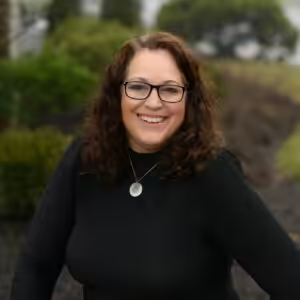
Stacie Porter Bilger is the Founder and President of Proof Digital, a business growth-marketing agency that blends modern marketing tools with traditional sales funnel processes. She spent the first 20 years of her career working with businesses to strategize development and connect them to investors. Before founding Proof Digital, Stacie worked for several Chambers of Commerce and startups like the Indiana Venture Center. Her commitment to leveraging cutting-edge digital tactics has revolutionized business growth strategies, cementing her status as a digital marketing thought leader.



Here’s a glimpse of what you’ll learn:
- [02:12] The story behind Stacie Porter Bilger’s career journey
- [03:37] Stacie’s transition from the public sector to tech
- [06:09] What startups taught Stacie about business growth
- [09:44] Leveraging data and predictive analytics in shaping business strategy
- [14:28] The pivotal moment Stacie knew she needed to be an entrepreneur
- [21:29] Why community involvement is essential to Stacie’s mission
- [26:36] How digital marketing evolved from illicit tricks to branding and strategic positioning.
- [31:51] The consistent principles driving Proof Digital’s success
In this episode…
How did a passion for public finance and economics lead to founding a digital marketing powerhouse? What pivotal moments and strategic insights shaped a leader’s path in the ever-evolving marketing world?
Performance marketer Stacie Porter Bilger exemplifies the power of strategic pivots in today’s digital landscape. With a background in public finance and political lobbying, Stacie transitioned into digital marketing by leveraging her passion for connecting people and communities. Her approach, grounded in uplifting clients and communities through innovation, connection, and a commitment to positive impact, has fueled Proof Digital’s growth into a digital marketing powerhouse driven by cutting-edge tools like AI and competitive intelligence. Stacie’s journey underscores the importance of adaptability, strategic networking, and staying ahead of market shifts.
Tune in to this episode of the Proof Point podcast as guest host Paul Miller interviews host Stacie Porter Bilger, the Founder and President of Proof Digital, about her digital marketing journey and the founding of Proof Digital. Stacie explores marketing concepts that have stayed constant amid technological shifts, reflects on the role of community engagement in her career trajectory, the integral role of trust in client relationships, and how staying nimble can promote success.
Resources mentioned in this episode:
Quotable moments:
- “Always keep learning, keep moving, and know that magic can happen if you are connecting and elevating others.”
- “Never give up. Never give up. I never give up. I think that’s Winston Churchill.”
- “Companies that do not pivot do not survive. They don’t survive.”
- “If you’re not paying attention to AI, you won’t be successful in the coming decade in business.”
- “I am passionate about helping more companies. The bigger we get, the more impact we’ll have.”
Action Steps:
- Embrace AI and automation: Incorporate AI tools into your digital marketing strategy to enhance efficiency and effectiveness. This step is crucial for staying competitive as AI can streamline operations and offer predictive insights, a significant opportunity.
- Leverage competitive intelligence: Utilize data analytics to understand your competitors’ strengths and weaknesses. This approach helps businesses identify market opportunities and strategically position themselves, addressing the challenge of differentiation in a saturated market.
- Prioritize connection and networking: Take calls and make strategic connections to foster partnerships and collaboration. Building relationships can lead to unexpected opportunities and growth, even in challenging times.
- Adapt and pivot with market changes: Stay agile and ready to pivot your business strategies in response to economic or technological changes. This proactive approach ensures resilience and adaptability, which are crucial for handling disruptions like those experienced during the pandemic.
- Focus on community involvement: Engage with your community and participate in volunteer work to build a solid local network and enhance your business’s social impact. This involvement not only enriches personal growth but also builds trust and reputation.
Sponsor for this episode…
This episode is brought to you by Proof Digital.
We are a strategic and creative performance marketing agency partnering with organizations to create data-fueled marketing engines that drive growth and deliver a tangible ROI.
Founded by Stacie Porter Bilger in 2012, Proof Digital employs a strategic marketing approach by blending today’s marketing tools like SEO, PPC, and paid social ads with traditional sales funnel processes.
Ready to get results? Visit https://proofdigital.com/ to learn more.
Interview Transcription – Behind the Brand: The Proof Digital Journey to Digital Success
(0:02- 0:12)
Welcome to the Proof Point Podcast where we decode digital success one click at a time. We share key takeaways fueled by data and insights that your team can implement today to drive growth. Now, let’s get started.
(0:21 – 0:40)
This is Paul Miller, today’s guest host for the Proof Point Podcast, where we feature B2B and D2C businesses and thought leaders, sharing marketing, data tactics, sales strategies, and leadership insights that will kickstart your growth in this rapidly changing digital space. This episode is brought to you by Proof Digital. Proof Digital is a strategic and creative performance marketing agency.
(0:45 – 0:51)
We partner with companies to create data-fueled marketing sales funnels. Visit proofdigital.com to learn more. We’re switching it up a little bit today.
(0:58 – 1:14)
Our guest today is Stacie Porter Bilger. Stacie is the leading force behind Proof Digital, where creativity meets performance in the realm of digital marketing. As founder and president, she is dedicated to revolutionizing business growth strategies by blending cutting-edge, digital, data-driven tactics with proven sales funnel strategies.
(1:20 – 1:25)
She constantly thinks of the ways she can leave a bigger mark and change the world. It’s an internal force that pushes her forward, keeping her focused on doing her best. Stacie, thanks for this opportunity to guest host your podcast today.
(1:31 – 1:46)
Thanks, Paul. It’s going to be a fun conversation. I’m kind of switching the mic to you. I appreciate it. I appreciate you, the team, wanting me to jump on and do this. Yep. The interviewer becomes the interviewee. Yeah. Yeah.
(1:48 – 2:09)
It’ll be fun. Absolutely. Today, we wanted to talk, first off, about decoding Proof Digital’s success and your story. This started about 12 years ago. We wanted to just get a feel for how it happened. I’m guessing you didn’t just wake up one day and think, I want to start a digital marketing company.
(2:14 – 2:19)
Getting to where you are today while rewarding, I’m sure it wasn’t real easy either. I’d like to hear more about your time before Proof. That said, what did you originally study in college and why? Yeah, that was a long time ago, Paul.
(2:25 – 2:43)
I look a lot younger than I am. I’m just kind of being funny there. Yeah. The internet wasn’t a thing when I went to school. I studied public finance and economics. Although my values haven’t changed since then because it’s still very much driven by me.
(2:49 – 3:04)
I wanted to make a mark. I wanted to get involved in the community. I had a few different passions. I thought those skill sets would help me have a knowledge base to kind of help disrupt things and elevate a community. I was interested in tax policy. I was interested in education as well, education policy.
(3:10 – 3:18)
I can actually remember writing a plan to start a school in college. Also in college, like I said, the internet didn’t exist. The top of mind of setting a digital marketing firm wasn’t a thing.
(3:25 – 3:46)
I can remember being in a lab sitting next to a guy, probably my senior year in college, who was writing this code and talking to somebody in Japan. I thought that was the coolest thing. How do you do that? So the curiosity of leveraging the internet, it did exist in its kind of black hole, but not very many people had accessed.
(3:52 – 3:59)
But my curiosity started probably in that lab. Absolutely. I remember the days of when the internet was kind of a barren land with tumbleweeds, if you will.
(4:04 – 4:13)
So there was just a lone shop, if you will, in the middle of nowhere, and speaking metaphorically, if you will. So at the end of the day, it was very sparse and lots of unfound territory. So it’s real fascinating.
(4:21 – 4:51)
That said, talking about creating plans for schools and such, you also spent a lot of your time in your early career in the public sector and with lobbying specifically. Why was that a passion for you? Was it tied with that experience in college or can you expand on that? I mean, yeah, I’m still so driven by just connecting individuals, businesses and communities to grow and to elevate my impact. And it was then, I was always learning.
(4:57 – 5:08)
It was a great way for me to really learn a lot about how public policy is made and how a community functions. And the more I learned, actually, the closer you get to an issue, the more complex it is. So I have more grace and understanding about how complexities that there are in the community that makes it run.
(5:13 – 5:33)
I have a whole lot of appreciation for the leadership that I was able to see in my community. And when people came together to solve a problem or connected people, magic did happen. And I definitely had a passion for education. So I did put those things to work. I helped pass the charter school law in the state of Indiana. So in that charter, that school idea, even though I did, I was more of the connector.
(5:40 – 5:53)
I was more of bringing people together to help those things happen. Indiana Internet was something that I helped birth and connecting students to jobs or internships. And I just saw kind of really a big butterfly effect person who you make connections, other bigger things happen.
(5:59 – 6:15)
Same thing, parent proof. It’s kind of very similar. I mean, it’s just basically connecting where it makes sense to elevate a business, to elevate an organization. So it’s pretty much still a theme in my career. Very cool. Yeah, that makes a lot of sense.
(6:20 – 6:41)
And with that, like you’re saying, connecting students with jobs and connecting people, and especially with the fledgling days of the Internet, I can certainly see where your experience with startup came into play. What from that experience has helped you most in building your own company? Yeah, basically from 2004, 2010, I worked for an organization called the Indiana Venture Center. That organization no longer exists.
(6:47 – 6:52)
That was the second career. I mean, the first one was a political lobby. And I did that for a decade. And then I did this for another several years and working with startups. I did it a little bit after that, too. I learned a whole lot.
(6:57 – 7:15)
I mean, that was also the birth of Google. I mean, there was a lot of transitions. I mean, actually, when I was in the political world, I can remember when everybody was making all those hand over fist money by being in the tech space. And I’m like, gosh, I missed out on that. And then I started learning and hanging out with all these tech folks. And I had the honor.
(7:21 – 7:56)
I mean, I worked for a guy whose name was Mike Hadfield. He started that nonprofit for Indiana Venture Center, along with universities and a few others, who the goal was to increase innovation in Indiana and trying to get talent to stay within that innovation. I saw and Mike Hadfield, he made his, I think it’s got to be behind the dollar amount that he did well with when Sarant was, I think, sold for $7, $8 billion back in 99 for fiber optics.
(8:02 – 8:19)
Again, fiber optics, right? That was the beginning of the speed of the internet. That was the big. So I got to learn from a couple smart people. And all these people and most of those ideas that came to the Venture Center did not, that failed. I mean, that’s what happens in business. They were, they were putting their ideas out.
(8:26 – 8:36)
They were trying to solve kidney dialysis issues. I think I’ve told this story, there was a guy who said he could solve cold fusion. He did not. Otherwise, you would have heard about that one. But I would connect him to a professor in Notre Dame. Because he knew physics, I didn’t.
(8:42 – 8:56)
And so is this for real or not for real? And he said, No, it’s not for real. And so, you know, I learned from a lot of people who were okay, taking risk and the common theme with all these companies. I mean, yes, that innovation and technology needed to work back to the guy and it needed to work.
(9:02 – 9:23)
But how do I get in front of that potential customer? How do I explain what problem I solve? And how are people going to see that my product or service is going to make their life better? And how do I get in front of them? And I started doing I would work with these universities to competitive intelligence. And that’s before the game changed. The game change of competitive intelligence and data about having helping these small to medium sized companies grow changed.
(9:28 – 9:49)
I mean, that was always a big ticket item, you pay big bucks to get some data insights, or you call the the secretary at the competitor’s office to see if they would share what’s latest, because they didn’t they weren’t queued in that they couldn’t share, you know, so and so was doing this thing. So you would call companies and try to get insight that you can still do that. But right now on competitive challenges, I can look at any company and to a lot of members on our team and say, this is where they’re weak.
(9:53 – 10:11)
This is where they’re targeting. This is where they’re making money. And I can see that with predictive analytics, I can see that with data, and a lot of tools we use. And so now, you small name size companies haven’t can can get into the game and clearly understand where they can businesses themselves in the market. And that’s, that’s, that’s what I got addicted to. And curiosity and learning.
(10:18 – 10:54)
I’ve always been that way. Especially in the tech piece. And it’s fun. Certainly, you know, and there’s some prominent influencers, one in particular, that uses the phrase day trading attention. And that really boils down to is, you know, getting that attention and finding ways to leverage the metrics and working on those parameters to improve that boost and reach. So yeah, one thing to mind while you were talking about that is the fact that you know, you’re connecting people with other people that may have not had that bridge before.
(11:00 – 11:18)
You yourself may not have had that bridge to, you know, even from a customer service standpoint to just general networking. We’ve heard you say the phrase, take that phone call. And you know, what what does that mean to you? And then why is that important to you? Well, I’ll give you a little personal story on that. Okay. And this is before this was before Google took off. So this is this is this is the lesson in connectivity.
(11:26 – 11:45)
And it’s full circle for me. I got a call from a business gentleman named Bob Bowen. He had a Bowen engineering pretty big company, well known company in Indianapolis region, a guy who was committed to the community. And he wanted to, he was a big Purdue guy, big Purdue guy. And you know, I’m an IU person. That’s okay.
(11:51 – 11:58)
I’ll, I’ll, I’ll forgive, I’ll forgive those. I have a lot of people who are Purdue people in my life. But what what he wanted to do is increase diversity in the engineering field, across races, across gender, you know, economic places.
(12:11 – 12:21)
And so he called me and said, Hey, I want to Stacey, I heard you were involved in education. And I wanted, you know, I know, I’ve seen you in the, you know, the chamber board meetings. And I want, I want to work with IPS in Purdue to start this program called science found.
(12:28 – 12:34)
So I took his call. And then I called the superintendent at the time of pick up the phone right went right to the source. And said, Hey, Pat, we need to have lunch and coffee, bring your people who are in science and things.
(12:37 – 12:55)
Let’s talk with Bob and see how we can get this program going. And then I got to play golf with the president of Purdue and connect with him and, and say, work out the program details. And between us at the leadership level, we kind of put the parameters around the program called science bound.
(13:01 – 13:11)
And science bound over the years, it helped kids do that starting in eighth grade. And if they got through that program from eighth grade to senior year, they got full ride scholarships to Purdue. And there were a lot of people who did the implementation, I did the connection, I took the phone call, I connected.
(13:19 – 13:28)
In the end, that program called science bound became Purdue Polytech. And guess who went to Purdue Polytech, my son. So before he was even born, or a glimpse in my eye, I worked on science bound.
(13:36 – 13:46)
And science bound became a school decades later. And it changed his life to be truthful. He was going to a big school, it wasn’t a good fit, moved him over to Purdue Polytech. He’s doing fabulous. He’s in college. But it changed really and saved his, his life from a standpoint of appreciation education.
(13:51 – 14:13)
So full circle, I took the call, I did action. And my son benefited from it. So that’s why I’m passionate about it, Paul. That’s, that’s really incredible. Yeah. And it’s, it’s great, too, because that that’s a testament to something that I strongly believe in is that we’re all wired differently. And you really have to play on those strengths to succeed in this world. And you being able to say, hey, I know this is not the right puzzle for this puzzle piece. So right.
(14:21 – 14:28)
Is a perfect testament to that because flourish where you know, our brains work best. And so as a sidebar, I am a complete advocate for that. So that’s very cool.
(14:32 – 14:42)
I’m really happy to hear that, you know, he’s able to take advantage of that opportunity to take a couple of phone conversations. That’s beautiful. And it’s a beautiful story. But there’s a lot of other examples and practicals. I’ve made phone calls and somebody picked it up. Our friends in Nebraska, Blackburn.
(14:49 – 15:09)
Now, I need to get out of my own way and make some of those more phone calls myself to people who I think are gonna be helpful. But now we’ve had a, you know, I don’t know, here in a couple years, it’s gonna be 10 years of working with Blackburn, because I picked up the phone to call them and Krista took it. And now we’ve had that company grow, you know, by, you know, being a partner in their growth, and their evolution as we are now as a whole company, we’re helping them evolve into the technology world.
(15:14 – 15:27)
So taking people’s call listening and be, you know, I understand caution, but you know, there is a butterfly effect. And sometimes it comes right back at you, which it didn’t for me. Definitely.
(15:31 – 15:49)
So that said, you know, picking up the phone and giving them a call. What was the moment you knew that you needed to start your own company? Oh, well, when I didn’t have any, a lot of these ideas, these very talented people who had a lot of ideas, and I didn’t have an idea. But I knew my value and in my passion, again, on the connectivity and markets and my passion for technology and understanding it.
(15:54 – 16:09)
So I didn’t want to go when things this was back in 2009 2010 economy was not great. He was not a good time to start a company. But I didn’t want to go back to a traditional job. I just I didn’t think I could have my impact. And so I sucked it up and it was painful. It’s on and off.
(16:16 – 16:46)
It’s been painful. But I do have that freedom to fulfill that mission of mine of, of connecting and elevating through digital and technology. And I just did it and I’m and I keep on going and I keep on going and never give up, never give up. I never give up. I think that’s Winston Churchill. So that’s what made me stand.
(16:52 – 16:58)
I just love connecting. That’s great. And with that, too, there’s always with business, there’s going to be those peaks, valleys, you know, you’re in the sky, you’re you’re in the trenches, that kind of thing.
(17:02 – 17:15)
Can you talk to me a little bit about, I wouldn’t say, maybe specific examples, but just your philosophy on the needs to pivot? Because that’s a very important piece. We react to elements all the time. I mean, four years ago, we had to react to a completely remote world for a bit.
(17:20 – 17:30)
And even with that, we still adapted and contain those parameters. But, you know, nonetheless, other businesses had to, we had to kind of give them guidance along the way, too. So can you elaborate on your thoughts on pivoting in your organization? Yeah, I mean, you, you, you, I mean, economies change, situations change.
(17:37 – 18:08)
I would just came from an economic forum myself this morning, spent three or four hours looking at predictive kind of forecasting from non political, economic folks who actually are looking at the data. And but I mean, it’s important to be nimble. And to pivot companies who do not pivot do not survive. They don’t survive. There’s lots of disruption. I mean, I’ve been involved in disruption back in when I was in political world, that’s a disruption.
(18:16 – 18:31)
But Google disruption, the pandemic was a disruption, virtual, not virtual. We were set up economically before the pandemic to deal with that pivot. Watching economic data, what did we need to pivot to ecommerce? We pivoted to ecommerce more.
(18:38 – 18:47)
And we had a little bit, but we, I, we consciously said, okay, people’s consumer behavior is digital. We need to elevate our game on eCommerce, B2B and B2C. But B2C had already kind of matured a little bit.
(18:54 – 19:13)
B2B had is still evolving. And younger generations, more and more will require that. And understanding too, and keeping ahead and understanding where those big guys are going. Where, what’s, what’s, I mean, what’s the competitive market look like? I mean, I mean, Google’s changing all the time. They have algorithm changes. They have lawsuits that come after them.
(19:18 – 19:40)
You know, you have to, you have to look at what’s in the marketplace. Facebook, Facebook had some downturns, but that, you know, they bought Instagram. They other made some other good things. You have to watch those tools in which you leverage. Now, probably the biggest disruption, what we’re going to see in decades is AI. And we’re at the forefront of using AI. I’m on a panel here in a few weeks on AI. Learning again, stay in a hot head. You have to be able to pivot.
(19:44 – 20:05)
It’s going to change the way we work. And if you’re not paying attention to AI, you won’t, that pivot won’t be, you won’t be successful in the coming decade in business, because it’s going to dominate efficiencies, how we communicate, how we do, you know, do processes, all those things. There’s bad that comes with it.
(20:12 – 20:29)
You had to go, we had the pivot, Paul, you know this. Early when we started Proof, security wasn’t as bad. It wasn’t as bad. We didn’t have two step authorization, plus, you know, VPNs and all those types of things. Passwords, I mean, you know, how long they have to be. Heck, I would be embarrassed to show you the passwords we had on our, I mean, you know what they were, Paul, they were not good.
(20:34 – 20:44)
Like passwords spelled backwards or something like that. You know, just really bad passwords. And we have to stay ahead. And if you’re not staying ahead of the bad guys, you got to pivot for them too, because they’ll get you if you don’t. So you’re, you’re pivoting for new technologies. You’re pivoting for the bad guys.
(20:49 – 21:00)
You’re pivoting for other innovations. But certain things are constant and you have to, you have to stay with those. From our standpoint, okay, what problem do you solve? How are you going to make my life better? And tell me that story better.
(21:05 – 21:19)
And then you’re leveraging the technologies in the marketplace to figure out how to find those folks. Absolutely. You know, speaking of AI, I mean, that’s, that’s one that’s top of mind across the board. Right. So that said, I remember automation was also one that was a very big component here. Yeah.
(21:26 – 21:39)
So there’s a lot of people losing opportunities because of automation. But I think if you embrace it and become kind of a person that maintains it, or even, you know, kind of champions it in a way that you serve the tool for the greater good, there’s still opportunities to be had with your expertise. Right.
(21:44 – 21:50)
I think some people lose sight of that just because in the moment, it’s like, this is changing my world. But that keyword pivot, again, that’s the key thing is how you react. Right.
(21:56 – 22:19)
I can’t control the bad guy. I can’t, I am not in the AI, you know, I mean, chat and all those other ones that are out there that are innovating and I’m not in that room. Maybe someday I will be but I’m not. So I am and it’s not going away. I mean, that that would be that would be naive of me and anybody else. Do I think there should be guardrails? I do.
(22:26 – 22:45)
Just like the car. I mean, we’ve got seatbelts now, right? We didn’t always have seatbelts. So sometimes guardrails are important. And I hope we have guardrails, but it’s coming. And so I’m going to learn as much as I can and help my clients and our team in our community leverage AI to on the automation thing, the because it’s going to bring efficiencies. Yes.
(22:51 – 23:10)
Can it impact people’s jobs? Yes. But we also have a talent problem. AI will help do those things that nobody likes to do anyway. So I think there’s opportunity there. Efficiencies and streamlining some of those components that are additional challenges in the. You know, talking about community in that, too, you’ve always dedicated time for volunteering and serving on boards.
(23:16 – 23:28)
Can you elaborate on that as to why you’re passionate about that or any other mindset regarding it? I mean, it’s a very similar theme. There are just a lot of great people doing great work. And and I know, again, the closer you get to issues, the more complex you get.
(23:34 – 23:39)
And I’m I’m as committed to learning and making an impact where I can connecting, sharing a few pieces of knowledge. Like I said, I’m going to be on a panel on AI here in a couple of weeks. I work on helping women owned businesses.
(23:45 – 23:49)
I’m one, you know, and elevate those around me. Education is still a passion. I don’t spend as much time, but I I was served on charter school boards to help them set up good structures.
(23:55 – 24:01)
So they’re successful. So, you know, I think everybody needs to get involved in the community because if you if you’re not, you’re and what I mean by community, I mean, like in the mix of it, not over here on the side. I mean.
(24:08 – 24:36)
I was I watched a panel of women who are working on child care the other day, and I learned a heck of a lot of what all they’re doing and what a big issue and challenge it is for the state and the nation. And they had some great ideas that I had not thought of before. So I think it’s really important for everyone, really, as a member of a community to help, you know, elevate their impact where they can.
(24:44 – 24:59)
And I do that consistently with my skill set. That’s great. Yes, for sure. Because if you were involved in that community hub, you know, in in one of its many subsets, you can contribute to the vision and help lend to the cause. It’s more than just on the side, like you’re saying. And so I embrace that myself.
(25:03 – 25:08)
Absolutely. Yeah. And I saw when I was at the chamber, my first part of my career, and I saw a lot of folks, business leaders or community organization leaders who just I mean, who made Indianapolis better by their involvement.
(25:15 – 25:27)
So I had a lot of even they were mentors, even though they didn’t know they were my mentor. I saw them. You know, I don’t know if you’ve seen streets named by them, Binford, Sam Jones, others who really, you know, had some hard discussions in the back rooms.
(25:34 – 25:41)
No, no question. But they really worked on community issues. And Glick, I mean, others in our community, there’s just so many that I saw close up and sometimes afar.
(25:49 – 25:55)
And I know our community is better for it. It’s it’s incredible, you know, the amount of impact a person or group of persons could have, you know. That said, too, I mean, we’ve covered a lot of different pieces of your story.
(26:04 – 26:32)
It’s busy. It’s got a lot of moving parts all the time. And throughout your career, you’ve balanced your work with a personal life and family. You know, how how do you work around a lot of those day to day grinding elements to for family and personal enjoyment, fun, et cetera? Well, there’s good days and there’s bad days. Definitely. I mean, when my kids were in the throes of their busyness, it was harder.
(26:38 – 26:44)
And to be truthful, I didn’t have as much time to work on growth for proof. It was it was harder in those early years because I was a mom. I was a mom, too, who, you know, had energy issues and lots of things.
(26:49 – 26:57)
So I, you know, some days I did it good and some days I didn’t. But I definitely focused. I mean, for the years, it was them first.
(27:03 – 27:19)
There’s no question. So that’s that’s where the now the reverse is kind of happening there. They’re in college. They’re starting their own journey. And so now I’m actually pivoting a little bit more back to those values and goals of what I want to do a little bit more than I did. How did I do it? I don’t know.
(27:25 – 27:45)
I got I have a cold plunge and I would jump in every once in a while, wake myself up. I have a great husband, too, by the way. Yeah, yeah. Having a good partner in life, a good support system is key, be it within the family hierarchy and even within your organization, you know, your your community of colleagues and co-workers and so. And that’s the truth, Paul. We have we have a team that has each other’s back.
(27:52 – 28:03)
And it’s hard. I mean, we could be going bigger and lots of other things, but we’re we are a community that kind of has each other’s back. And that’s that’s helpful. Yeah. And that’s not lost on me. So I think I’m speaking for all of us when I say we really appreciate that.
(28:08 – 28:33)
Absolutely. Approved digital. I’d like to shift now to your time specifically here at Proof Digital because October is your 12th year in business. Fun fact, did you know that the traditional 12 year anniversary materials are silk and fine linen? These two natural fabrics symbolize security and comfort of a long lasting relationship. That seems fitting to say the least. I didn’t know that.
(28:44 – 28:53)
I guess I should feel a little bit more relaxed with that. I don’t know. And it’s kind of a testament to the fact that, you know, we’ve had some clients for the long haul and we’ve helped them pivot. We’ve adapted to changes that they needed to adhere to, et cetera. And I guess so can fine linen it’ll be. Yes.
(29:03 – 29:16)
So the year is 2012. What did Proof look like at that time? Well, we were a lot smaller. I mean, I mean, we’re not massively big now, but we were just a, you know, me and a couple part time people at the time.
(29:25 – 29:50)
We were navigating kind of change in the market because we were, we were really only SEO focused at the time. Mainly in website builds and the, you know, just kind of getting clients in front of when somebody was searching for them. But there were, there were some big guys in the market on that and they crashed and burned because they were trying to trick Google. We never did. And we focused on branding. We focused on, you know, helping strategically position clients.
(29:59 – 30:08)
And then we use some of that online competitive intelligence to help them grow. And there were people who out there who were trying to trick the system and that didn’t last very long. And they all crashed and burned.
(30:14 – 30:21)
So we came out of it because of, you know, the digital space had a little bit of bad taste, you know, credibility issues because of that. But we never played that game. So that’s what 2012, we were small, we were mighty.
(30:30 – 30:37)
We focused on the basic business data aspects and continued to learn. Reminds me of the tortoise and the hare, right? Yeah. We were tortoise.
(30:43 – 30:59)
We still are a tortoise, but it’s, it’s probably better, right? Well, integrity is key for sure. And it is definitely stands the test of time for a lot of the accomplishments that I’ve seen in my time here, even that, you know, speaking of, you know, the, the credibility and things like that. I would, this is a two-part question.
(31:04 – 31:27)
What was your biggest challenge in the early years? And what would you say your biggest challenge is now? I mean, it’s, it’s similar, but now we have, you know, one is to gain that credibility and gain those clients. I really didn’t tap into my previous network. Like I could have really to be truthful because I was learning and I was just trying to understand to make sure that I was doing good work.
(31:34 – 31:58)
But, you know, gaining new clients is always a challenge and then finding the right team along the way that helped us kind of go to another level. Early team members valued them greatly, but, you know, but as we’ve evolved, we’ve evolved into help, helping those systems and solutions as we’ve grown. So that’s the, that’s the biggest challenge, but keeping going to, I mean, going back to the never give up.
(32:05 – 32:15)
There was a lot of days of never give up. Okay. And the biggest challenge now, I mean, I think we’re in a place of, and we’ve made progress on working through systems to help scale.
(32:21 – 32:38)
So we can go to the next level and putting those systems in place so that we can now that we’ve learned a lot and how do we balance those types of things? The biggest challenge now, I don’t know, Paul, what do you think the biggest challenge now is? I mean, business development is always a challenge. Economic turns are always a challenge. Sure.
(32:43 – 32:57)
Yeah. And, you know, and this day I see a lot of companies kind of hunkering down and really focusing on their own challenges. And with that, sometimes it comes kind of back of mind to maybe reach out for a leverage partner to help assist with that.
(33:04 – 33:08)
Yeah. I know sometimes when I get overwhelmed, I just embrace it all and start, you know, trying to take it all on myself instead of saying, Hey, I’ve got these three little things, maybe, you know, tackle that. And I can tackle this and then put it all together at the end.
(33:14 – 33:30)
Right. Also, I mean, for me, other challenges, just facing the security pitfalls head on, on top of those, that’s always evolving very fast. Technology changes rapidly across the board, but, you know, we do our best to embrace, learn and grow with those as well.
(33:36 – 33:46)
So, yeah, that part I wouldn’t call so much as a challenge, as much as just a necessary part of the day. And with everything going on task wise and projects and things like that, it’s just something that you have to definitely keep on your list and check off at the end of the day. Yes, I did this.
(33:51 – 34:02)
Yes, I did that. Yeah. I mean, that’s it. I mean, the challenge even then and now, what do you focus on today that moves the needle? Because there’s a lot of distractions that can happen. My day can get hijacked pretty quickly. But the biggest challenge and it’s true.
(34:09 – 34:33)
I mean, things move. I think the last decade, things move quickly. I mean, it’s going to be lightning the next in the digital space.And that’s probably going to be a challenge for folks. We’re up for it. And like you started on our intro, it’s just helping our clients adapt to the rapidly changing digital space. And we do that. We’re students of it. Yep, absolutely.
(34:37- 34:52)
You know, when you kind of touched on the changing technology and how it’s evolved over the years, I think it’s important to note that we have adapted to a lot of those changes. Like I was saying, we want to stay on top of the trends, make sure that we’re embracing those changes. What is something that’s always stayed the same at Proof Digital? Well, back to the, I mean, driving our clients back to the fundamentals first.
(34:59 – 35:16)
I mean, that’s not changed. I mean, I say it all the time. What problem do you solve? How are you going to make their life better? And what’s the story? I mean, what makes you credible? And how do I engage with you? Helping through those systems to get there. Our commitment to our client success. I mean, we love our clients. We think about them every day.
(35:23 – 35:54)
I mean, so it’s not like a, I mean, it’s just like, it’s not a business exchange. It says we’re two feet invested in the success of our clients. And that’s never changed. And sometimes you might lose money on some of those deals, but it’s in the long run, it pays off because you’re building partnerships. So that’s not changed. Yeah, I think what has changed is the tools we use, but they’re still solving the similar problem, but with even more insights.
(36:00 – 36:25)
I mean, heck, I think when you were talking about my first career, exterior email didn’t exist. And I was doing mass faxes to people to get a message out. Bug the heck out of them. They didn’t appreciate it, especially for the home business when they got the fax in the middle of the night. But now, I mean, now it’s so overwhelming of where do I, I mean, that was a simple solution. Now there’s so many options where, and it’s important to understand where your potential client’s hanging out.
(36:32 – 37:15)
Absolutely. I haven’t thought about the fax machine in years. Yeah, it’s going to be in museums. Yep, most certainly. What would you say are some of Proof Digital’s key milestones? Well, I mean, being still a young company, even though 12 years, I mean, the first year, the second year, early on that you’re still doing it, because that’s when they first, that’s when they fail the most. I mean, I think our pivot during COVID was, I mean, we moved downtown right before, you know, a year or so before COVID.
(37:20 – 37:34)
We had a nice space, loved it. That was a good pivotal, fun period of time. But then the milestone was, okay, here we go. We’re going to, you know, never give up, never give up, never give up. Even in the midst of, I mean, we had clients who couldn’t pay their bill. They were in markets that were more hit than others.
(37:39 – (37:39
We pivoted to ecommerce. And now we are, you know, have really expertise across WooCommerce, across BigCommerce, across Shopify. So we really kind of put two feet in that as a key milestone, I think.
(37:52 – 38:06)
And just the team development the last couple of years have been great. I can agree with that. I feel like, you know, as a musician, one key important element to music is rhythm.
(38:11 – 38:27)
And I think with a team, that rhythm is equally important. It is. I feel like all of our departments and their interminglings are harmonious, rhythmic, et cetera. So I’ve seen a lot of involvement and growth in the past few years, especially. So that is certainly a testament to it. And appreciating each other.
(38:31 – 38:54)
I mean, I was a softball player. I think I’ve always given this analogy and everybody on that team, we were like number one in the state, different skill sets, different personalities. But everybody, you know, steps up to the plate of what they do best. And they cross-train too. And so we really kind of got that great rhythm of a team that would be envious by most companies. Sure.
(38:58 – 39:13)
Absolutely. You know, with smaller organizations, wearing many hats is a very important part of keeping things going and having everybody kind of aware of key day-to-day ins and outs as others may have to weave in and out is very important. It’s very handy for me to say the least.
(39:20 – 39:55)
So we have seen 12 years of Proof-Digital in action and, you know, there’s no stopping. What would you say are some goals for Proof-Digital over the next 12 years? Well, the more, I mean, it’s not necessarily something different. I mean, I want to continue to grow and learn our knowledge base so we can still save that, you know, solve that same problem of connecting and growing companies by being, helping them be the answer when somebody is looking for their, and then, you know, helping them think about strategically on how to grow, like Blackburn, I mean, leveraging technology to grow.
(40:03 – 40:24)
I’m passionate about helping more companies and the bigger that we get, the more impact that we will have. And so my vision, my personal vision is still continually to, you know, plant seeds and help businesses and individuals grow, expand and elevate their impact. And that’s really, if I get up every day to do that, even for the next 12 years, that’s a good day.
(40:31 – 40:45)
So does it look different? I mean, it’s gonna, it’s gonna evolve. It’s going to look different. We’re going to be leveraging technology even more or different partnerships to do more, but the businesses are here and our impact to the more skills we get, the bigger, you know, bigger is a relative term.
(40:50 – 41:19)
I don’t know, I don’t have a number. I don’t think that’s, you know, I’m going to be so many employees. I think that’s actually the wrong measurement of a company.So I think every month working on building more client bases so that we have a bigger impact and bigger footprint on making the companies and organizations around us better. Yeah. In turn, those companies will, you know, our goal is to help them achieve bigger impact, bigger reach.
(41:26 – 41:32)
Yeah. And even in the nonprofit that I work with, a lot of times it’s about building generational wealth. And I think the more we elevate communities and companies and people that just will move the needle on things.
(41:40 – 41:59)
So that’s, I don’t know, what do you think what it should look like in 12 years, Paul? It’ll be, we’ll be using different tools. That’s for I think, you know, for me, it’ll be fascinating to look back 12 years from now and still have that mindset or not mindset, but just that phrase, the more things change, the more they stayed the same, right? Business will always be business. Companies will always, you know, kind of come and go and the market will always shift.
(42:04 – 42:17)
And so we will just have to keep the sneakers on and, you know, bob up and down the court and play ball accordingly. What I can’t envision yet about the technologies of an, I mean, what’s, what we’ve seen in the last two years is just crazy. I mean, the tools, I mean, just crazy.
(42:23 – 42:47)
Anybody gets an AI and is using it from a process standpoint. I mean, it’s just, it’s game changing. And so what does that look like in 12 years? I mean, there’s some scariness to that too, but I view it as a challenge and exciting to, to, to help companies navigate. Absolutely. These challenges and opportunities. Yes.
(42:53 – 43:05)
Well, here’s to 12 and many more years of Proof Digital. And, you know, Stacie, thank you for you first off. It’s an honor to share the world and exist at the same time as many people, yourself included. And I’m not just saying that to say it, but I feel, you know, I love you and value you like every day. Likewise. Absolutely.
(43:12 – 43:41)
I think I speak to the whole team with that sentiment as well. One last question, of course, is what final proof point do you want to leave with our listeners? Always keep learning, keep moving and know that if you are, you know, the amazing things that can happen if you are connecting and elevating others in business or community, magic can happen. So keep learning because if you don’t, you get stale.
(43:48 – 43:54)
So we’re, we’re here to keep learning for our clients and keep ahead of things. And so I guess that would be a good proof point and never give up. Never give up.
(44:02 – 44:11)
Indeed. I can certainly agree with that. Well, this has been me, Paul Miller. I’ve been the guest host for the Proof Point Podcast. We’ve been talking to Stacie Porter Bilger, founder of Proof Digital. I really appreciate you sharing your story with us.
(44:16 – 44:25)
You know, I’ve heard bits and pieces in our talks in the past, and it was great to really elaborate on your vision, your experience and your history. And we really look forward to sharing this journey with you going forward. Thanks, Paul.
(44:27 – 44:31)
I appreciate you. Thank you. Thanks for listening to the Proof Point Podcast. We’ll see you again next time, and be sure to click subscribe to get future episodes.