
TLDR: In 2025, SEO stopped rewarding volume and started rewarding credibility. The brands that won didn’t publish more content; they built more trust. FAQs, author bios, real stats, and proof-based storytelling didn’t just improve rankings. They increased visibility in AI results and drove real revenue. That momentum carries straight into 2026.
At a Glance:
- Trust signals now power rankings, AI visibility, and conversions, not just “good content.”
- EEAT isn’t theoretical anymore. It’s measurable, buildable, and necessary.
- SEO, AI visibility, ads, and CRO now share the same foundation: credibility.
- The fastest way to rank in 2026 is to prove expertise, not claim it.
In 2025, search changed. Not quietly. Not subtly. It changed in ways that forced marketers to confront an uncomfortable truth:
Publishing more content stopped working.
AI Overviews rolled out. Generative search results took center stage. Users stopped clicking ten blue links and started scanning synthesized answers instead.
At Proof Digital, we spent 2025 doing something that felt almost boring compared to chasing the next tactic or algorithm update: we built trust.
We focused on FAQs, author bios, stat cards, reviews, and case studies. Real expertise, clearly documented and easy to verify.
The result? Better rankings. Stronger visibility inside AI-powered search. And, yes, sales driven directly from AI tools like ChatGPT, where one of our clients was discovered and ultimately landed a major job.
Here’s what worked, why it worked, and how you can carry that momentum into 2026.
The New Best Practice: Credibility Over Content Volume
Content still matters, but volume isn’t the end all, be all. In 2025, it became clear that publishing more pages doesn’t automatically improve visibility, especially when those pages repeat the same ideas without adding proof.
The old SEO model rewarded output. Publish frequently, optimize aggressively, and expand coverage until you owned every variation of a keyword. Authority was supposed to follow.
However, modern search systems (AI search engine optimization platforms in particular) don’t evaluate effort. They evaluate confidence and credibility.
The pages that performed best in 2025 didn’t win because they were longer or more “SEO optimized.” They won because expertise was impossible to miss: clear authorship, specific examples, and verifiable claims.
When search engines and AI systems encountered those pages, they didn’t just understand the topic. They trusted the source.
This is what SEO credibility looks like now. A smaller set of well-supported pages can outperform massive content libraries when those pages clearly demonstrate experience, authority, and relevance.
This shift is even more pronounced in local SEO strategy. Pages that include localized FAQs, real project examples, reviews tied to specific services, and visible ownership will outperform thin location pages built purely for coverage.
Search Didn’t Kill SEO. It Exposed Bad SEO.
For years, thin pages ranked, repetitive blogs gained traffic, and volume masked the absence of authority.
That’s stopping in 2026.
Over the past year, AI-driven search experiences forced a harder evaluation of content quality. Systems began prioritizing sources that demonstrated real expertise and consistency over time.
That’s where EEAT SEO stopped being a theoretical framework and became a real-world ranking factor. Not just for traditional results, but for AI-generated summaries as well.
What is EEAT? At its core, it’s how search engines and AI systems decide which sources deserve to be cited, surfaced, and recommended. EEAT breaks down into four signals:
- Experience: Proof that content comes from first-hand, real-world involvement, not abstract commentary.
- Expertise: Demonstrated subject-matter knowledge, credentials, or depth that goes beyond surface-level insight.
- Authoritativeness: Recognition and validation from the broader industry or ecosystem.
- Trustworthiness: Accuracy, transparency, and consistency across content, authorship, and brand presence.
In 2025, EEAT Google principles stopped being optional. They became the baseline for visibility across both search results and AI-driven experiences.
The 5 Trust Signals That Moved the Needle in 2025
We didn’t guess our way through this shift. We tested it across industries, measured results, and refined what worked.
1. FAQs That Answered Real Questions
Most FAQ pages exist to pad content or chase keywords.
In 2025, we rebuilt FAQs to do real work. They addressed objections, clarified decisions, and answered questions users actually ask before converting.
Understanding how to write an effective FAQ page now means writing answers that stand on their own. AI tools often pull these responses directly into summaries, so clarity and structure matter as much as completeness.
If you’re wondering how to write FAQs for modern search, the rule is simple: answer like a human, but structure like a machine. Check out a client example below.

The tone and approach of the YOURspace FAQ is conversational and reassuring, but the structure is logically sequenced to satisfy modern search requirements. The sentence can stand on its own when pulled by AI.
That balance supports SEO for AI overviews and traditional rankings at the same time.
2. Clear Authorship That Reinforced Expertise
Anonymous content lost ground quickly in 2025. Search engines and AI systems became far less likely to surface content when it wasn’t clear who created it.
We focused on clear authorship. Blogs, guides, and case studies were attributed to a real person with a role that matched the subject. You can see an example of this at the bottom of every Highmark TechSystems blog.
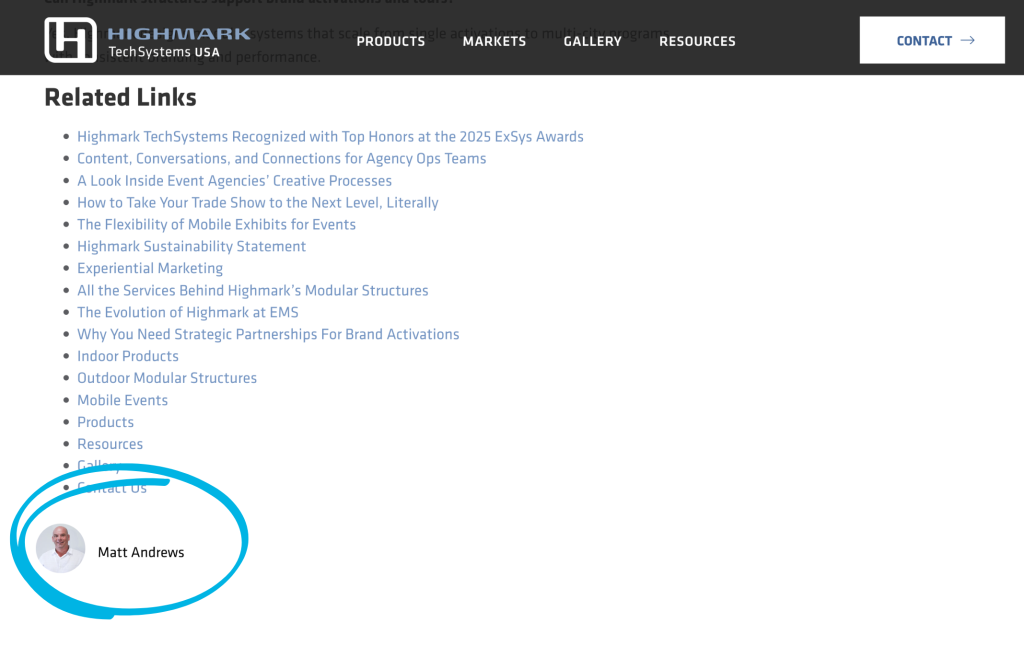
That alignment strengthened EEAT by making experience and accountability visible. It also supported generative AI search engine optimization, since AI systems evaluate authorship and role relevance when selecting sources.
Readers respond the same way to this SEO strategy. Clear ownership builds confidence, especially for high-consideration decisions.
3. Stat Cards That Gave AI Something to Quote
AI loves specificity and avoids vague claims.
We asked clients to fill out a comprehensive set of performance metrics that we provided, then introduced those structured statistics across key pages. The stat cards highlighted benchmarks and outcomes tied directly to real work, not abstract claims.
This approach gave AI systems clear data to reference, improved featured snippet eligibility, and strengthened sales conversations with proof that was easy to validate.

Stat incorporation reinforces generative search engine optimization without resorting to manipulation or keyword stuffing.
4. Reviews That Build Trust and Reduce Friction
In 2025, reviews became more than social proof; they acted as credibility shortcuts for both buyers and AI. The focus shifted from collecting more reviews to placing them where trust decisions happen: service pages, landing pages, and comparison content.
Short, context-specific quotes near key claims or calls to action proved more effective than long testimonials buried at the bottom of a page. Reviews reinforced promises instead of doing all the persuasion themselves.
From an AI perspective, reviews added external validation. For users, they reduced hesitation, answered objections, and made conversion feel safer, accelerating action when trust signals were close to decision points.
5. Case Studies That Closed the Loop
Few trust signals carry more weight than proof. Case studies show that your strategy works in real-world conditions, not just in theory.
A strong case study for SEO does more than list outcomes. It connects the dots between the problem, the decisions made, and the results achieved. Check out this case study that achieves all three. That context matters—for both search engines and human readers—because it demonstrates experience, not just success.
Case studies also translate well to AI-driven search. They give generative systems structured narratives, clear cause-and-effect, and verifiable signals that support credibility. Instead of simply surfacing a brand, AI can confidently reference it.
For buyers, the impact is just as important. Case studies reduce risk. They answer the unspoken question of “has this worked before?” and replace abstract promises with documented results.
2026: Trust Is the Differentiator Across Every Channel
Trust doesn’t belong to SEO alone. It influences how ads perform, how landing pages convert, how quickly deals move, and how often brands get recommended…by people and AI systems alike.
Every channel pulls authority from the same foundation. Weak trust signals slow everything down, and strong ones amplify every tactic. The above seo strategies are infrastructure, not a siloed effort.
A Trust-Building Checklist for 2026
You don’t need a full rebuild. You need visible signals of credibility. Here’s what you can work on right now:
- Add an author name and role to your top 10 pages today.
Start with blogs, guides, and service pages. Match the role to the topic (ex. SEO strategist, account lead, subject expert). - Review your FAQs and rewrite one answer per page.
Pick the most common buying-stage question and answer it directly, without marketing language. If it wouldn’t satisfy a real prospect, rewrite it. - Pull three real metrics from client work or internal data.
Add them to high-intent pages as simple stat callouts. Be specific. “Improved performance” means nothing, numbers do. - Turn one successful project into a lightweight case study.
No design required. Write three short sections: the problem, what you did, and what changed. Publish it where prospects already evaluate you. - Audit one page for proof gaps.
Ask: Would a skeptical buyer trust this page? Would an AI system know why this source is credible? Add one signal that answers yes.
Stop Chasing Visibility. Build Credibility.
Search didn’t get harder. It got more selective.
The brands gaining momentum now aren’t gaming algorithms or publishing endlessly. They’re earning trust by making expertise obvious, experience verifiable, and proof easy to find.
Each strong signal reinforces the next, across search, AI, ads, and conversion.
If you want an SEO approach that holds up as platforms evolve, stop chasing visibility as the goal. Build credibility instead.
If you’re not sure where your trust signals are helping—or holding you back—Proof Digital can help. We work with brands to turn credibility into discoverability, and discoverability into growth. Let’s talk.
FAQs
What is EEAT, and does it matter for SEO in 2026?
EEAT stands for Experience, Expertise, Authoritativeness, and Trustworthiness. In 2026, it plays a direct role in how search engines and AI systems evaluate content quality, credibility, and whether a source deserves to be surfaced or cited.
How does EEAT impact AI-driven search results?
AI systems prioritize sources that demonstrate clear expertise and consistency. When content aligns with EEAT principles, it becomes more likely to appear in AI summaries, recommendations, and results generated by AI search engine optimization tools.
Are FAQs still important for SEO?
Yes, but only when they’re written for real users. Strong FAQs support modern SEO best practices by answering questions clearly, while also giving AI systems structured, extractable information.
What role does authorship play in modern SEO?
Visible authorship tied to relevant roles helps search engines and AI tools evaluate credibility. It strengthens EEAT signals and supports both traditional rankings and AI-generated search experiences.
How do case studies support SEO and AI visibility?
Case studies that follow content seo best practices provide context, proof, and real-world outcomes. They reinforce trust signals used and give AI systems concrete narratives they can reference when summarizing expertise.
Do trust signals matter for local SEO?
Absolutely. Reviews, localized FAQs, real examples, and clear ownership often outweigh backlinks or keyword density in a strong local SEO strategy, especially as AI systems evaluate relevance and credibility together.
What’s the biggest SEO mistake brands will make in 2026?
Focusing on volume instead of proof. Ignoring seo best practices rooted in credibility—like authorship, clear metrics, and documented experience—will limit both rankings and AI visibility.
Related Links
- How to Structure Blog Content for AI Search
- How To Write Alt Tags For SEO
- EEAT Is The Key to High-Quality Content that Ranks
- Why Your SEO Strategy Needs FAQs and How to Do It
- How to Be the Best Answer in AI Search
- Everything You Need To Know About Search GPT
- Generative Engine Optimization (GEO): What You Need to Know
- AI in Digital Marketing
- Our Work
- Let’s Talk