
The Blog SEO Best Practices Checklist

Good content doesn’t rank on its own. Structure is what gets it there.

You can have great writing, solid research, and a compelling topic and still get almost no organic traffic. Nine times out of ten, the missing piece is structure. Use this checklist to build posts that Google can categorize, AI tools can surface, and readers can actually navigate.
structuring blog content for SEO

Topic & Search Intent

Before you write a word, make sure you’re writing about the right thing. A well-structured post on a topic nobody searches for won’t rank no matter how good the content is.

Topic Validation

Defined the question this blog is answering
Every post should have one clear question at its core. If you can't say it in a sentence, the topic is too vague to rank for.
Confirmed someone would realistically Google this topic
Interesting ≠ searchable. The topic needs to match actual search behavior, not just internal assumptions about what readers want.
Topic is specific (not too broad or vague)
Broad topics have too much competition and don't serve any single reader well. Narrow to something your site can credibly own.

Too Broad:

Memorial Stones, SEO Tips, Product Photography

Too Specific:

What Materials Are Used for Headstones?, How to Write Alt Tags for SEO, Product Photography Lighting for White Backgrounds

Post-Level Structure

These elements define how your blog post is understood by search engines, AI tools, and readers before they read a single paragraph. Get them right first.

Title Tag, H1, & Meta Description

Title tag is keyword-forward and under 60 characters
This is your pitch to Google and to the searcher scanning results.
H1 is distinct from the title tag
Your H1 is your pitch to the reader who already clicked. You have more room to be human and specific here.
Meta description is written fresh and under 160 characters
Include a primary keyword and a clear benefit of reading. Think of it as ad copy. A better meta description improves click-through rates, and higher CTR signals relevance to Google.

Tip:

Your URL slug should also be short and keyword-rich. /blog/how-to-structure-a-blog-post-for-seo beats /blog/post-june-2026-v3-final every time.

TLDR & Key Takeaways

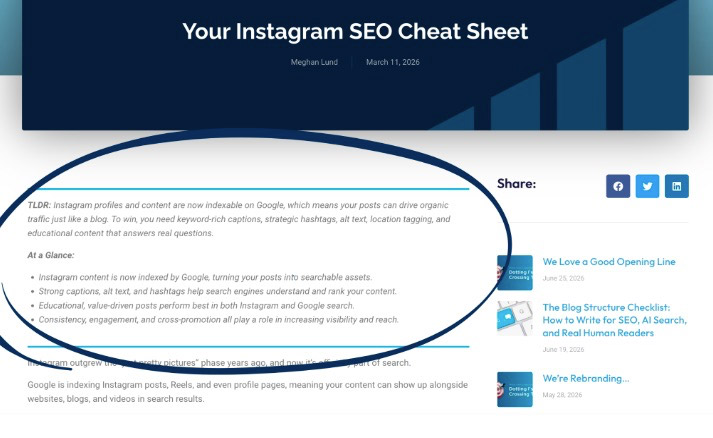
Include a 1–2 sentence TLDR at the top of every post
AI tools often pull from the top of a page when generating summaries. A clear, keyword-informed TLDR increases the chance your language shows up in AI answers rather than a paraphrase of it.
Follow the TLDR with 3–5 Key Takeaway bullets
Each bullet should be a standalone, quotable statement. Together they signal to Google what the page is about, fast.

Tip:

Write your TLDR and Key Takeaways after you’ve written the post, not before. They’ll be sharper when the content is already in front of you.

Keyword Strategy

One clearly defined primary keyword
This is the specific phrase this post is built to rank for. Everything else supports it.
At least 3–5 supporting keywords mapped before writing
These cover related questions and help signal topical depth to search engines.
Long-tail question keywords identified and woven in
These are the conversational queries people actually type and increasingly speak to AI assistants. They map directly to featured snippet and AI Overview opportunities.

Tip:

Modern search engines read context, not keyword density. Write naturally. Use keywords where they fit, not twelve times in 800 words.

How to Find Keywords (Quick Method)

Before writing, spend 5–10 minutes doing this. No special tools required.
Google your topic
Type your idea into Google and look at: autocomplete suggestions, "People also ask" questions, and related searches at the bottom. These are real things real people search.
Scan what's already ranking
Click the top 2–3 results and note what topics they cover, what headings they use, and what questions they answer. Your post should match or improve on this.
Pick 1 main keyword + 2–4 supporting phrases
Example — Main: "headstone materials" / Supporting: "types of headstones," "granite vs marble headstones," "what headstone lasts longest."

Local Relevance Keywords

Service area mentioned naturally (city / state)
For location-based businesses, local signals matter. Work your city or region into the content where it reads naturally.
Local context included if relevant (weather, regulations, regional norms)
Local specificity builds credibility and differentiates you from national competitors publishing generic content.
Local keywords not overused or forced
Stuffing city names into every sentence reads as spam to both Google and your readers. Once or twice, naturally, is enough.

Content Structure & Readability

How your content is organized determines whether readers stay, whether Google ranks it, and whether AI tools can pull from it. These are non-negotiable fundamentals.

Heading Hierarchy (H2s & H3s)

Each H2 stands alone as a clear, keyword-informed answer
If you pulled every H2 out and read them in sequence, they should tell the story of the article. A vague heading like "The Solution" is not ready. "How a Weighted Dip Tube Solves Last-Drop Spray Bottle Problems" is.
H3s that drill down, not decorate
Use H3s as subpoints within an H2 section. They should add depth, not just break up the visual rhythm of the page.
Every heading is specific enough to work as a standalone snippet
If Google surfaced just that heading as an answer in search results, would it be useful? That's the bar.

Weak Headings:

The Innovation, Our Approach, Why It Matters

Strong Headings:

How a Weighted Dip Tube Fixes Last-Drop Spray Bottles, Why Heading Hierarchy Determines Blog SEO Rankings, What AI Search Tools Pull From Blog Content

Paragraph Length & Readability

Paragraphs are 3–4 lines max
This isn't about dumbing content down. It's about respecting how people actually read online, which is mostly scanning until something hooks them.
One idea per paragraph
If you can't say it in three lines, you probably haven't fully worked out what you're trying to say. Break it up, add a subheading, and let the content breathe.
Numbered lists and bullets used for scannable, multi-item content
Structured formats are far easier for AI to parse and cite. A dense wall of essay-style text might be beautifully written but will rarely get surfaced in AI Overviews.

Expertise & Credibility

Shows real experience or firsthand knowledge
Google's quality guidelines increasingly reward content that demonstrates genuine expertise. Generic advice that anyone could write ranks lower than specific, experience-backed insight.
Includes phrases that signal authority
Language like "We've worked with…", "In our experience…", or "We've seen this happen when…" grounds the content in real expertise rather than theoretical knowledge.

Images & Alt Text

Every image has descriptive alt text with a relevant keyword
Alt text should describe what's actually in the image while working in a keyword naturally. Not "image1.jpg." Not "photo of product." Every image is a small SEO opportunity.
Images are compressed and formatted for fast load
Large images slow pages down, which hurts both user experience and SEO. Compress before upload (most platforms won't do it for you).

Avoid:

image1.jpg, photo of product, screenshot

Do This:

Tilted™ spray bottle adapter shown on a Tolco sprayer, Dashboard screenshot showing automated workflow trigger for new lead entry

Structuring Content for AI Search

Questions in headings are answered directly in the first 1–2 sentences of that section
AI systems are looking for direct, clearly formatted answers, not context buried after three paragraphs of setup.
Sentences are complete and pull-quotable on their own
Ask: if Google surfaced just this one sentence in a search result box, would it make sense standalone and answer the question?
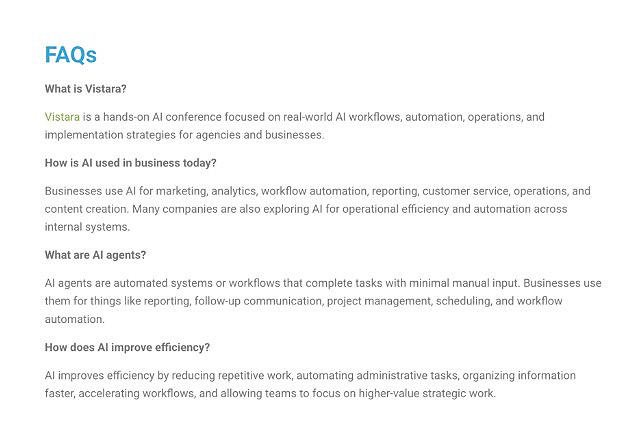
Post includes a FAQ section (2–3 sentences per answer)
A well-structured FAQ is essentially a pre-formatted answer feed for AI. Each question is a long-tail keyword. Each answer is a potential AI Overview citation.
Definition-style paragraphs used where appropriate (term + explanation)

These are easy for AI tools to parse and attribute. Lead with the term, follow with the explanation.
Internal Linking

2–4 internal links to related pages on your site

This signals topical authority to search engines, keeps readers on your site longer, and passes link equity to the pages you want to rank.

Anchor text is descriptive, not generic
"Browse our lineup of professional cleaning sprayers" beats "click here.” Link naturally from a phrase that describes the destination.

Tip:

List out target pages before writing begins. Knowing which pages you want to support before you start drafting shapes where you naturally bring topics up.

Metadata Layer

URL slug is short, clean, and keyword-rich
Set before publishing and never change it without a redirect.
Title tag and meta description reviewed before publishing
These don't show up on the page, so many teams forget them. Build the review into your publishing workflow.
Featured image has proper alt text and is correctly sized
1200 × 628 px is the standard for blog featured images. This also ensures the image looks sharp when shared on social platforms.

Call-to-Action (CTA)

Tells the reader what to do next
Every blog post should end with a clear next step. Readers who reach the end are your most engaged visitors — don't leave them without direction.
CTA is relevant to the topic, not a generic "contact us"
The best CTAs connect directly to the post's subject. A headstone guide should end with something like "Get help choosing the right material" — not just "Learn more."
Not overly salesy — helpful, not pushy
Readers came for information. Earn the next step by being useful, then invite them forward naturally.
Mentions service area or location where relevant
For local businesses, grounding the CTA in geography ("serving the greater Denver area") reinforces both trust and local SEO signals.

Examples of Strong CTAs:

“Contact us to learn more about headstone options in [City]” · “Talk to our team about what works best for your timeline.”

Minimum Blog Requirements

Before submitting or publishing, verify these baseline standards are met.

Word Count:
800–1,200+ words
Section headings (H2s):
At least 4–5
FAQ section:
At least 3 questions with answers
Call-to-Action:
1 clear, topic-relevant CTA

Related Resources

Take your content further. Explore our additional guides to ensure your blog is fast, visible, and built for the way search works today.

Ready for a Content Strategy That Actually Performs?

Structure is just the start. The brands winning in organic and AI search are publishing content that’s well-researched, properly optimized, and built around what their audience is actually searching for.
;