Eric Simpson leads paid media at Proof Digital, where he builds Shopping and Performance Max campaigns for ecommerce brands that want their product feed working as hard as their ad budget.
TLDR: Google Shopping ads help ecommerce brands reach shoppers who are ready to buy by showcasing products based on feed quality instead of keywords alone. With a well-optimized Google Merchant Center feed and the right campaign strategy, businesses can improve visibility, drive more qualified traffic, and maximize return on ad spend.
At a Glance:
- Google Shopping ads match products to high-intent searches using product data, giving businesses the opportunity to compete on product quality, price, and relevance instead of brand recognition.
- A well-maintained Google Merchant Center feed is essential because accurate product data improves visibility across paid Shopping ads, free product listings, and Google’s AI-powered shopping experiences.
- Choosing between Standard Shopping and Performance Max depends on your goals, available data, and desired level of campaign control, making strategy just as important as budget.
- Managing Shopping campaigns requires ongoing feed optimization, campaign refinement, and performance analysis, and Proof Digital helps ecommerce brands build campaigns that deliver stronger long-term results.
If you sell products online, you have probably heard that you need Google Shopping ads. What most explanations skip is why they work so differently from a regular search ad.
A shopper searching for a product does not see a headline you wrote. They see your product photo, your price, and your store name sitting next to every competitor selling the same thing.
That shopper is not looking for a brand they already trust. They are looking for the right product at the right price, right now.
That single shift, from bidding on keywords to bidding on purchase intent, is what makes Shopping ads uniquely powerful for product businesses, especially newer or challenger brands with no name recognition to lean on.
So, how do Shopping ads actually work? Why do they convert as well as they do? And where does Google Merchant Center fit into it all? Here’s what to know.
What Are Google Shopping Ads?
Shopping ads are visual product listings. Each one shows an image, a title, a price, and a store name, and they show up on Google Search, the Shopping tab, Google Images, and a growing number of other Google surfaces.
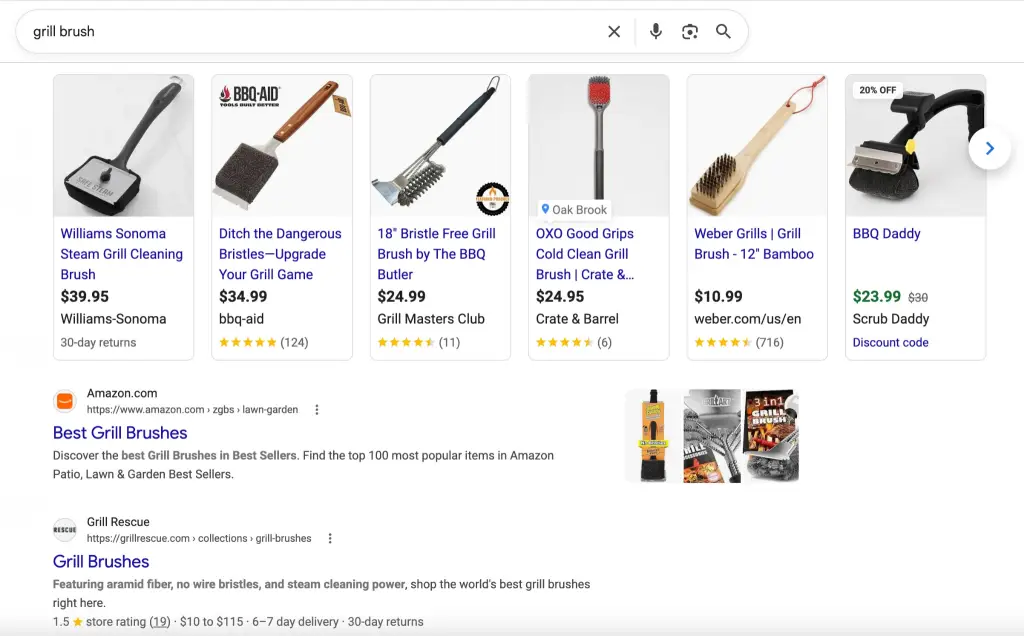
The format alone sets them apart from a standard text ad, but the bigger difference sits underneath.
Text search ads run on keywords you choose and bid on. Google Shopping ads do not work that way. You do not pick the search terms your products show up for. Google matches your products to relevant searches based entirely on the product data you provide.
Bid strategy still matters in product listing ads, but it is not the engine. The data is the engine.
Shopping Ads Run on Intent, Not Brand Recognition
Here is the strategic case for Shopping ads, in four parts.
First, they level the playing field at the exact moment someone decides to buy. A shopper comparing options sees your listing next to established brands, and they judge it on product, price, image, and reviews. Not on whether they have heard of you before.
Second, they bypass the brand awareness gap entirely. You do not need thousands of people to already know your name. The product does the convincing. A sharp photo, a fair price, and solid reviews can outperform a familiar logo, because the shopper is not evaluating your brand story. They are evaluating whether this product solves their problem.
Third, they can deliver measurable ROI while brand equity is still being built. Early-stage and challenger brands often cannot afford to wait years for awareness to compound. Shopping campaigns can produce trackable revenue in the near term, and that performance can buy the runway needed to invest in slower channels like content, SEO, and organic social.
Fourth, they enable a genuinely competitive strategy. Because your product is matched at the point of highest purchase intent, you can compete directly in the moment a buying decision gets made, instead of trying to win attention earlier in the funnel where brand-name competitors have the advantage.
Put those four together and the thesis is simple: Shopping ads meet shoppers at the point of highest purchase intent and let the product speak for itself.
Curious what that could look like for your catalog? Talk to our paid media team.
Google Merchant Center: The Engine Behind Your Shopping Ads
If Shopping ads run on product data instead of keywords, that data has to live somewhere. That place is Google Merchant Center, and this is the part of the system most business owners never see but absolutely need to understand.
Merchant Center is where you upload or sync your product feed: titles, images, prices, availability, and structured attributes like size, color, and material. Google reads that feed and matches it to what people are searching for.
This means your feed quality is your ad performance. A vague title, a blurry image, a stale price, or a missing attribute does not just look sloppy. It can keep your product from showing at all, or show it for the wrong search entirely.
Product feed optimization is the difference between a campaign that performs and one that quietly underdelivers.
That same Merchant Center feed also feeds free organic product listings and product answers inside Google’s AI Mode. One well-built feed compounds across paid, organic, and AI surfaces at the same time.
That is a meaningful shift, and it is exactly where SEO and paid media stop being separate conversations.
Standard Shopping vs. Performance Max
Smart Shopping does not exist anymore as its own option, so the real decision today comes down to two live Google Shopping campaign types.
Standard Shopping campaigns give you more control and more transparent reporting. You can see performance by product group, adjust bids where you want, and understand exactly where your budget is going.
Performance Max hands more of that control to Google’s automation. It uses the same product feed to place your products across Search, Shopping, Display, YouTube, Gmail, and Discover, and it optimizes toward your goals automatically across all of them.
Neither one is inherently better. The right call depends on how much control you want to keep, how much conversion data your account already has to work with, and how comfortable you are letting automation make placement decisions.
This is exactly where an experienced hand adds real value, since choosing the wrong structure early on can cost months of learning time you never fully get back.
What Shopping Ads Cost and How to Measure ROI
Google Shopping ads cost money the same way any pay-per-click channel does, and your ad budget runs separately from the free organic listings your feed also generates. Results get measured through conversion tracking and return on ad spend, not impressions or clicks alone.
Here is the honest answer to the question everyone actually wants answered: the biggest driver of cost efficiency is not your budget size. It is feed quality and campaign structure.
A clean, well-optimized feed can help your ads win more relevant matches without you needing to outbid the competition on every search. A messy one can push spend toward the wrong searches no matter how large the budget gets.
Results can vary by category, competition, and how mature your feed already is, so treat any campaign as a process to refine rather than a number to set once and leave alone.
Run Shopping Ads In-House, or With an Agency?
Plenty of businesses run Shopping campaigns in-house, and for a small, clean catalog with straightforward products, that can work just fine.
Complexity is where things get harder to manage alone. Large or messy catalogs, recurring feed disapprovals, Performance Max campaigns that need real optimization, competitive product categories, and the ongoing grind of keeping product data accurate all add up fast.
Ecommerce PPC at that scale is less about launching a campaign and more about maintaining one, and that maintenance is where a lot of in-house efforts quietly stall out.
This is where a dedicated paid media team like Proof Digital earns its keep, whether that means untangling a struggling feed, restructuring a Performance Max campaign that is not pulling its weight, or building ecommerce and omnichannel marketing strategy from the ground up.
If Shopping ads sound worth exploring for your catalog, our paid media team can walk through what that would actually look like for your products.
Ready to see what your catalog could do with a stronger feed and a sharper campaign? Talk to our paid media team.
FAQs
How do Google Shopping ads work?
Google shopping ads run on your product feed instead of keywords you bid on. You upload product data like titles, images, prices, and availability into Google Merchant Center, and Google matches that data to relevant searches automatically. You do not choose the search terms directly. You control the inputs, and Google decides the matches.
What is the difference between Shopping ads and Search ads?
Search ads are text-based and triggered by keywords you select and bid on. Shopping ads are visual product listings, built from your product feed, and Google decides which searches they match to.
Do I need Google Merchant Center to run Shopping ads?
Yes. Google Merchant Center is where your product feed lives, and Shopping ads cannot run without it. It is also the same feed that can power free organic product listings and product answers inside Google’s AI Mode, so a well-built feed does more than just fuel paid ads.
Are Google Shopping ads worth it for a smaller or newer brand?
Often, yes, and sometimes more so than for an established brand. Because Shopping ads match on product data rather than brand recognition, a newer brand can compete for the same searches as bigger names without needing existing awareness.
How much do Google Shopping ads cost?
Google Shopping ads cost varies by product category, competition, and account maturity, so there is no fixed number that applies across the board. What tends to matter more than raw budget is feed quality and campaign structure, since a clean feed can help ads win more relevant matches without requiring higher bids on every search.
Should I run Performance Max or Standard Shopping campaigns?
It depends on how much control you want and how much conversion data your account already has. Standard Shopping gives clearer, more granular reporting and control. Performance Max uses automation to place your feed across more Google surfaces at once. Neither is universally better, and the right structure often depends on the specific catalog and goals.
Related Links
- Paid Media (PPC/SEM)
- 4 Ad Types You Need To Use In 2025
- Why You Need To Market With Carousel Ads
- Meta Ads Learning Phase: What Changes Help or Hurt Performance
- Creating Ecommerce Experiences
- Your Product Category Page SEO Checklist
- Everything You Need To Know About Search GPT
- Ecommerce and Omnichannel Marketing
- Lead Generation Strategy and Tactics
- Digital Assets
- AI in Digital Marketing
- Our Work
- Let’s Talk